ORRAA’s Karen Sack speaks at PRI event in Amsterdam
Date: 15 Oct 2026
EventsOpinions
Transitions, solutions and blind spots: what are responsible investors missing?
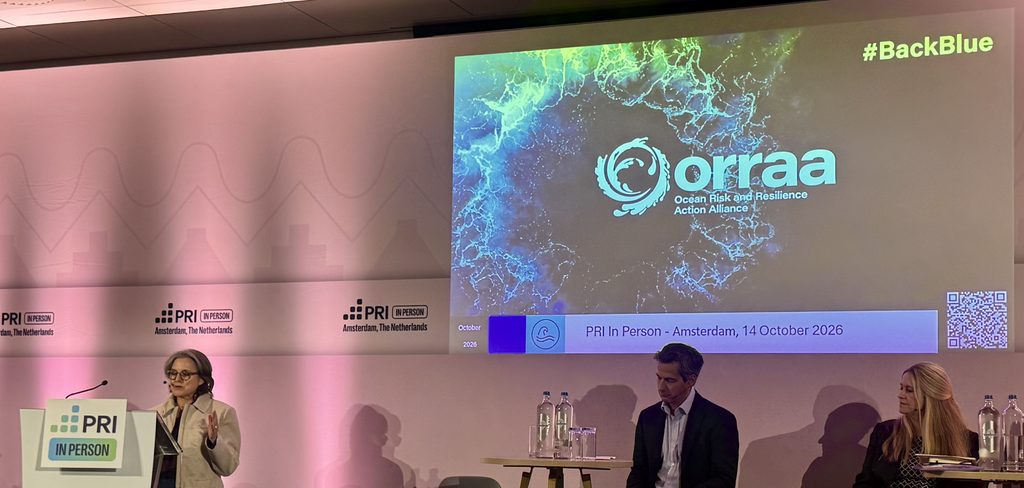
Karen Sack, Executive Director of the Ocean Risk and Resilience Action Alliance, spoke at the Principles for Responsible Investment (PRI) in Person on 14 October 2026in Amsterdam.
I am here to argue that the Ocean should be a core part of your investment strategy. Why? Because the Ocean is not an ESG footnote, not a line in a stewardship report, but a factor sitting inside every fiduciary decision each of you makes.
Let me start with a number many of you already manage. Across the OECD, pension funds, insurers and sovereign wealth funds oversee more than $100 trillion in assets. Of that, less than 0.1 percent – around $69 billion – carries a publicly disclosed “blue” mandate.
Meanwhile, the Ocean economy itself already contributes an estimated $2.6 trillion a year to the global economy and underpins food security for three billion people; independent analysis from the OECD projects it will reach $5.1 trillion by 2050.
That gap – between the capital you hold and the capital you’ve put to work in the system that underwrites your entire portfolio – is the case I am putting to you today.
Here is the first argument: the Ocean is not a sector. It is infrastructure, sitting underneath the insurance, reinsurance, sovereign debt and supply chains that every one of you already holds. Seven of the nine planetary boundaries that keep the Earth system stable have now been breached, and the Ocean sits at the centre of that system – absorbing around 90 percent of the excess heat and a quarter to a third of all the carbon dioxide we have emitted since the 1980s. That buffering has a cost: ocean pH is now at its lowest level in at least 26,000 years.
You may hold no coastal property directly. But you hold the insurer that prices it, the reinsurer behind that insurer, the sovereign bond of the country whose GDP depends on its ports and fisheries, and the consumer goods company whose supply chain runs through a warming, acidifying sea.
Ocean risk does not stay in the water. It propagates through equities, fixed income, infrastructure and private markets alike.
Here is the second argument: this is not charity, it is arithmetic. Research estimates a $2.8 trillion investment in sustainable ocean systems could generate $15.5 trillion in returns by 2050, a multiple the High-Level Panel for a Sustainable Ocean Economy independently puts at five to one. Nature itself is outperforming the infrastructure we build to replace it: mangroves, reefs and seagrasses deliver a four to 10 times return on investment versus grey infrastructure, and keep paying out for decades, not quarters.
Here is the third argument, and it is the one I know best: this works, and it works now. I lead the Ocean Risk and Resilience Action Alliance (ORRAA). In five years, our alliance has invested $26 million directly into 50 finance and insurance products across 30 countries, and mobilised a further $140 million in private and philanthropic capital behind them, a leverage ratio of three to six for every dollar committed. That capital has helped build the resilience of more than 500,000 climate-vulnerable coastal people, 45 percent of whom are women, and protected nearly 1.4 million hectares of ocean and coastal ecosystems.
Small Island States, the Big Ocean States, steward roughly 30 percent of the world’s Ocean, 40 percent of its coral reefs and 20 percent of its biodiversity, on behalf of just 65 million people; purpose-built vehicles like Outrigger Impact’s blended finance fund now exist to put capital directly to work there, backed by a technical assistance facility that gets projects investment-ready. The proof of concept is no longer the question. Replication and scale are.
The main perceived challenges for investing in ocean regeneration and coastal resilience are generally threefold, so let me take them head-on.
First: that ocean returns are too long-dated and illiquid. But you already hold infrastructure and private assets with ten and twenty-year horizons – the Ocean is no different, except your other assets quietly depend on it.
Second: that the data isn’t mature enough to underwrite at scale. True five years ago; it is why we built parametric triggers, guarantee structures and blended vehicles that price this risk today.
Third: that this is someone else’s mandate – a development bank’s job, a philanthropy’s job. But public and philanthropic capital was only ever meant to prove the model and absorb the first loss. It cannot take the opportunity that our own analysis puts at roughly $550 billion a year through 2030 in just six regenerative and sustainable ocean economy sectors. Over half of it is in Asia and those investments incorporate sustainable protein and circular economy investments. Only capital of the size sitting in this room can take that on.
Under the PRI’s six Principles, you have already committed to incorporate ESG issues into your investment analysis and decision-making, to be active owners, and to seek appropriate disclosure. Applied consistently, those commitments lead to the Ocean – not as an exception to responsible investing, but as responsible investing, applied without a blind spot. You do not need to take my word for it: our Blue Lines report, published this June, lists the Principles for Responsible Investment alongside the Equator Principles, the Poseidon Principles and the TNFD as part of the existing rules of the road for this transition – you are already named in the map we’ve drawn.
It is time for your blue voyage to begin. Our #BackBlue Ocean Finance Commitment now counts Deutsche Bank, AXA, Standard Chartered and BNP Paribas among its endorsers, representing $4 trillion in assets under management, mapped against six investable sectors from ocean-based renewable energy to sustainable aquaculture, so asset managers know exactly where to point capital. As the report’s own foreword, written by three global leaders from Latin America, Europe and Africa put it: the Ocean is a systemic financial asset, and its degradation represents a growing source of unpriced risk across the global economy – while its restoration remains one of the largest untapped investment opportunities of this century.
So, my ask of this room is not abstract. Ask where ocean risk and opportunity currently sit in your portfolio – because right now, for most of you, the honest answer is that it is invisible. And the biggest risk you now take, is inaction on this sector. Because inaction here is inaction everywhere.
Back the instruments already built to de-risk this asset class, so capital can move at the speed the science demands. And where you are already convinced, bring someone else into the room with you, because the leverage in this market comes from crowding in, not going it alone. Join the #BackBlue Ocean Finance Commitment.
We called our own organisation into being because the Ocean was invisible in mainstream finance, even though it underpins our economies, our climate, our food systems and the security of billions. That invisibility is a choice this industry made, and can unmake.
There are two things that unite people around the world: the Ocean and football. During New York Climate Week, we announced a new collaboration with Liverpool FC to bring these two global unifying forces together. We are planning a convening of #BackBlue joiners at Anfield during this season.
For Liverpool, for us – this is far from a game.
A regenerating Ocean is a stabilising force in an uncertain world. Destabilise it, and everything else you have built your portfolios on becomes more fragile.
Recognise it instead for what it is: living capital, undervalued, underpriced, and an evolving source of risk, but very open to those prepared to act first to move from a trajectory of decline to future-proofed recovery, resilience and profitability.
From Red Lines to Blue Lines, Redrawing How We Invest in a Regenerative Blue Economy From Red Lines to Blue Lines, Redrawing How We Invest in a Regenerative Blue Economy is a new report, published by ORRAA in collaboration with the WEF ACT Ocean and UNEP Finance Initiative. It provides clear guidance to financial institutions on
Knowledge and Learning BriefLessons from the Field: From Local Innovation to Scaled Investment Over the past four years, ORRAA has supported 50 projects in 30 countries, building the resilience of more than 500,000 climate vulnerable coastal people in the Global South, 45% of whom are
We use cookies to personalise content and ads, to provide social media features and to analyse our traffic. We may also share information about your use of our site with our social media, advertising and analytics partners who may combine it with other information that you’ve provided to them or that they’ve collected from your use of their services.
This website uses cookies to improve your experience while you navigate through the website. Out of these, the cookies that are categorized as necessary are stored on your browser as they are essential for the working of basic functionalities of the website. We also use third-party cookies that help us analyze and understand how you use this website. These cookies will be stored in your browser only with your consent. You also have the option to opt-out of these cookies. But opting out of some of these cookies may affect your browsing experience.
Necessary cookies are absolutely essential for the website to function properly. These cookies ensure basic functionalities and security features of the website, anonymously.
Cookie
Duration
Description
cookielawinfo-checkbox-necessary
11 months
This cookie is set by GDPR Cookie Consent plugin. The cookies is used to store the user consent for the cookies in the category "Necessary".
cookielawinfo-checkbox-non-necessary
11 months
This cookie is set by GDPR Cookie Consent plugin. The cookie is used to store the user consent for the cookies in the category "Non-Necessary".
viewed_cookie_policy
11 months
The cookie is set by the GDPR Cookie Consent plugin and is used to store whether or not user has consented to the use of cookies. It does not store any personal data.
Functional cookies help to perform certain functionalities like sharing the content of the website on social media platforms, collect feedbacks, and other third-party features.
Performance cookies are used to understand and analyze the key performance indexes of the website which helps in delivering a better user experience for the visitors.
Any cookies that may not be particularly necessary for the website to function and is used specifically to collect user personal data via analytics, ads, other embedded contents are termed as non-necessary cookies. It is mandatory to procure user consent prior to running these cookies on your website.
Analytical cookies are used to understand how visitors interact with the website. These cookies help provide information on metrics the number of visitors, bounce rate, traffic source, etc.
Advertisement cookies are used to provide visitors with relevant ads and marketing campaigns. These cookies track visitors across websites and collect information to provide customized ads.