ORRAA at COP31
The 31st annual meeting of the Conference of the Parties (COP31) of the United Nations Framework Convention on Climate Change (UNFCCC), is scheduled to take place from 9 to 20 in November of this year in Antalya, Türkiye. Uniquely, it is being co-hosted by Türkiye and Australia under a partnership agreed at COP30 (Türkiye–Australia Partnership Modalities):
- Türkiye holds the COP31 Presidency, hosts the conference and the World Leaders’ Summit (11 to 12 November), and leads the COP31 Action Agenda. Murat Kurum, Minister of Environment, Urbanisation and Climate Change, is COP31 President-Designate.
- Australia, through Chris Bowen, Minister for Climate Change and Energy, is President of Negotiations, with authority to lead the conduct of the negotiations in consultation with Türkiye.
- The Pacific hosted the Pre-COP with the ministerial meeting in Nadi, Fiji, and a Leaders’ segment in Tuvalu, 5 to 8 October. Pre-COP amplified Pacific leadership and SIDS priorities ahead of Antalya, including keeping 1.5°C within reach, access to finance, and integrating the Ocean into climate plans.
The Ocean and Seas agenda is one of the COP Presidency’s ten priority themes. Its stated aim is to strengthen marine and coastal resilience through coordinated action on blue carbon, ocean observation, data sharing, finance, and implementation partnerships. The Ocean has a dedicated thematic day on November 17th under the Ocean, Seas, Nature and Land Use Day.
Stay in the know: Over the next several weeks, we’ll be updating this page with the latest information we have on events, venues and speakers. handled as separate tracks. They are truly integrated strategies for systemic climate resilience.
Delivering for the Ocean at COP31
At COP31, ORRAA aims to help ensure that ocean priorities already set out in national climate plans are matched with the finance that can deliver them. The COP31 Presidency’s framing of COP31 as a COP of implementation and prioritising Ocean and Seas agenda are a strong indication of the shift from setting ocean priorities to delivering on them. The Trabzon Call to Action – an outcome of a high-level convening in early September by Türkiye, also asks for “bankable ocean outcomes”. ORRAA and its members bring tested instruments and the cross-sector partnerships to help make that happen.
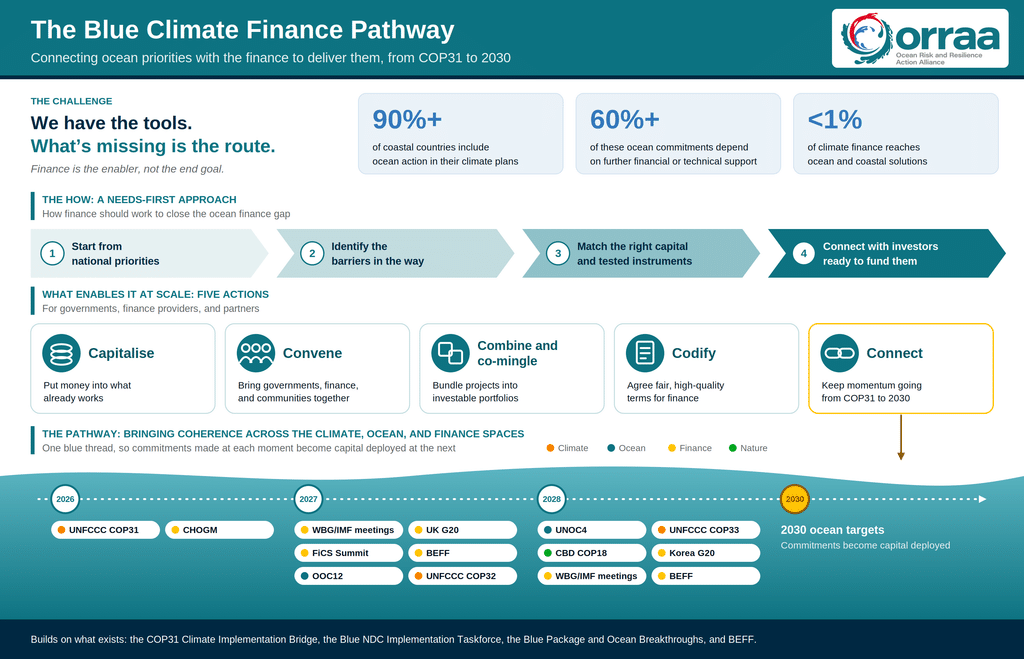
More than 90% of island and coastal countries included at least one ocean measure in their latest climate plans (known as Nationally Determined Contributions or NDCs), yet more than 60% of ocean NDC commitments are conditional on further technical or financial support. The challenge is not a lack of capital. It is that the right types of capital are not reaching the solutions that matter most through accessible and fit-for-purpose financing pathways.
There is a huge gap between national priorities, the instruments already built to deliver them, and the investors ready to fund them. Additionally, too often, those building finance products starts with what they have developed and look for a way to implement them. But effective delivery requires the reverse: starting from what countries and communities need, identifying the barriers, and matching the types of capital and instruments that can overcome them. In Antalya, ORRAA members and partners will be showing how, by working with local partners and bringing key stakeholders together from the beachfront to the boardroom, we have developed a blue finance and insurance product pipeline: fit for purpose products that deliver investment into coastal resilience and ocean regeneration. These include insurance products, impact funds, blue carbon, resilience and biodiversity credits, blue bonds, and guarantees.
We’ll be engaging through three key moments: the Leaders’ Summit and Business Forum (11 to 12 November), the Finance and Trade Day (13 November), and the Ocean, Seas, Nature and Land Use Day (17 November).
Our Secretariat team at COP31 will include Karen Sack, Executive Director, Chip Cunliffe, Senior Director, Ariane Steins-Meier, Director of Global Outreach and Engagement, Ghazal Zazai, Senior Associate of Global Outreach and Engagement, and Torsten Thiele, Senior Advisor of Blue Finance.
Blue Climate Finance Pathway
In the lead-up to COP31, we have been working with our members, to develop and propose a five-point ocean finance action agenda: a Blue Climate Finance Pathway that takes us from the COP31 to the 4th UN Ocean Conference in 2028. Its objective: to mainstream and scale blue finance. The Pathway consists of five practical actions that governments, investors, insurers, philanthropies, and civil society can take on their own or together:
- Capitalise: put money behind proven finance and insurance solutions that already exist and are ready to grow.
- Convene: bring finance ministers, development banks, investors, insurers, and communities to the same table to back the Ocean priorities countries have already set.
- Combine and co-mingle: Start from country needs and build investable portfolios: bundle smaller projects into viable deals, reduce risk with guarantees and insurance, and pair revenue-earning regenerative and sustainable blue economy projects with nature restoration that cannot pay for itself.
- Codify: agree what good ocean finance looks like: easy to access, fair on debt and responsive to shocks, aligned with country priorities and capacity, and designed with communities, not for them.
- Connect: link each global moment to the next, so momentum builds from COP31 to the UN Ocean Conference in 2028 and on towards global 2030 goals (i.e. SDG14, the Ocean Breakthroughs and the Kunming-Montreal Global Biodiversity Framework).
The Ocean at COP31: from recognition to finance
Click to read more
The common thread across 2026 has been a shift in the question: not whether the Ocean belongs in climate action, but how ocean priorities get financed. The milestones below have built that case, and ORRAA has contributed to each one, carrying the message that ocean priorities need fit-for-purpose finance to move from pilots and plans to scaled up action.
- 10-11 June, Bonn (SB64): UNFCCC Ocean and Climate Change Dialogue
- 13-14 August, Istanbul: Istanbul Ocean and Seas Workshop
- 10-11 September, Trabzon: Ocean and Seas Summit
- 21-22 September, Sydney: SCF Forum on financing climate action for water systems and the ocean (report will be published soon)
- 22-24 September, New York: New York Climate Week / UNGA high-level week, including a dedicated Oceans Solution Dialogue under Climate Summit for the first time
- 5-8 October, Fiji and Tuvalu: Pre-COP ministerial meetings and Leaders’ Segment, where Pacific Big Ocean States set the political tone for COP31 on ocean outcome
The climate action and implementation agenda has also seen advances on the Ocean.
- Blue Package and Ocean Breakthroughs. The Ocean Breakthroughs define five key tipping points for action by 2030 across marine conservation, food, energy, transport/shipping, and tourism. The Blue Package sets out ocean actions to 2028. Guided by the Ocean Breakthroughs and launched at COP30, the Blue Package is a roadmap for ocean-based climate solutions across the five high-impact sectors. Revisions to the Blue Package is expected by COP31.
- Blue NDC Challenge and Blue NDC Implementation Taskforce: The Blue NDC Challenge was launched by France and Brazil ahead of COP30 to call on all countries to integrate ocean-based solutions into national climate plans. The Blue NDC Implementation Taskforce was announced at COP30 and will be launched at COP31, to support country members to overcome common implementation barriers.
Find more information about COP31 from our members and partners: WWF, Ocean & Climate Platform, UNEP FI, IUCN, Conservation International, Environmental Defense Fund.
Events at COP31
ORRAA is collaborating with members on the events below. Details and additional events will be updated as they are confirmed. All times are Türkiye time (TRT).
| Date | Time (TRT) | Event Title | Hosts | Venue |
| Friday 13 Nov | 09:00 – 09:50 | Closing the Ocean Finance Gap: Creating a Blue Climate Finance Pathway | ORRAA, with BNP Paribas and AXA | Ocean Pavilion, Blue Zone |
| Friday 13 Nov | 14:00 – 14:50 | Convergence of finance, science and ocean action: mobilising capital to support ocean climate progress | Convex ORRAA speaking | Ocean Pavilion, Blue Zone |
| Tuesday 17 Nov | 08:00 – 10:00 | Financing Nature-Positive Transitions: From Ambition to Investable Climate and Nature Opportunities (Invite only) | KPMG and ORRAA | Sedir Hall, AKRA Hotel |
| Tuesday 17 Nov | 11:00 – 12:30 | Financing Coastal Resilience in Latin America and the Caribbean: From Climate Risk to Investment at Scale | CAF and ORRAA | IDFC Pavilion, Blue Zone |
ANNEX
In focus: COP31 in a nutshell
Click to read more
The 31st Conference of the Parties to the UN Framework Convention on Climate Change (UNFCCC COP31) takes place in Antalya, Türkiye, from 9 to 20 November 2026. For the first time, the Presidency is shared under a partnership agreed at COP30 (Türkiye–Australia Partnership Modalities):
- Türkiye holds the COP31 Presidency, hosts the conference and the World Leaders’ Summit (11 to 12 November), and leads the COP31 Action Agenda. Murat Kurum, Minister of Environment, Urbanisation and Climate Change, is COP31 President-Designate.
- Australia, through Chris Bowen, Minister for Climate Change and Energy, is President of Negotiations, with authority to lead the conduct of the negotiations in consultation with Türkiye.
- The Pacific hosted the Pre-COP with the ministerial meeting in Nadi, Fiji, and a Leaders’ segment in Tuvalu, 5 to 8 October. Pre-COP amplified Pacific leadership and SIDS priorities ahead of Antalya, including keeping 1.5°C within reach, access to finance, and integrating the Ocean into climate plans.
The Presidency’s theme is a “COP of Implementation”, guided by three principles: dialogue, consensus, and action. Its Action Agenda has ten priority themes, including Ocean and Seas, with finance, technology, and capacity building as cross-cutting enablers to support their translation into practical and scalable implementation pathways.
Key topics at COP31 relevant to ocean action and financing include:
- Climate finance delivery. The COP31 Presidencies call for continued focus on delivering the New Collective Quantified Goal (NCQG) and tripling adaptation finance by 2035, and will seek common ground on the future of the two-year climate finance work programme established at COP30.
Why it matters for the ocean: less than 1% of climate and development finance reaches ocean and coastal solutions, so how these goals are delivered determines whether that share grows. - Aligning finance flows (Article 2.1(c)). COP31 will discuss how the UNFCCC can support investment and align financial flows with climate goals, particularly Article 2.1(c) and its complementarity with Article 9.
Why it matters: this is the negotiated entry point setting policy direction for private and blended finance, where most ocean-economy investment sits. - Adaptation. COP31 is expected to advance the Global Goal on Adaptation through the full operationalisation of the Belém-Addis Vision on adaptation, including a technical taskforce on methodologies for the Belém Adaptation Indicators, and to complete the transition of the Adaptation Fund to serve the Paris Agreement exclusively.
Why it matters: coastal resilience needs to be measurable within these indicators to attract finance. - Loss and damage. The Fund for Responding to Loss and Damage is expected to approve its first funding requests later this year.
Why it matters: many of the losses coastal communities and small island developing states (SIDS) already face come from the ocean, such as sea-level rise, coastal erosion, and declining reefs and fisheries. - Paris fundamentals. Parties are encouraged to submit outstanding national climate plans (NDCs and NAPs) and second Biennial Transparency Reports by 31 December 2026. COP31 also marks the start of the second Global Stocktake, which concludes in 2028.
Why it matters: NDCs and NAPs are where ocean priorities become national commitments, and the second Global Stocktake will test whether those measures were financed and delivered. It concludes in 2028, the same year as UNOC4, so it is a natural checkpoint for ocean finance. - Implementation initiatives. The Belém Mission to 1.5 (report to be published soon), the Global Implementation Accelerator, and the COP31 Presidency’s Climate Implementation Bridge (BRIDGE) are presented as complementary implementation initiatives. BRIDGE is a new initiative designed to connect country-owned priorities and project pipelines with finance, technical expertise and implementation partners, with particular attention to developing countries, LDCs and SIDS.
Why it matters: these initiatives offer a route for the ocean measures already underway in most coastal and island NDCs and NAPs to move into implementation. - Access to finance. Australia launched an Access to Finance Statement and Action Plan, with a focus on reducing barriers that delay funding reaching vulnerable communities. The Statement is open to governments and organisations active in climate finance to endorse and implement.
Why it matters: access to grants and concessional finance is critical for vulnerable communities and countries to implement their ocean and coastal priorities. If ORRAA members and partners are interested in learning more, please contact the ORRAA Secretariat for further information. - Electrification. The COP31 President launched a “35 by 35” Global Electrification Pledge at New York Climate Week, inviting Parties to support raising electricity’s share of global final energy consumption to 35% by 2035.
Why it matters: offshore renewables, green ports and shipping electrification are ocean-based routes to the 35 by 35 goal. If well planned, with safeguards and benefit-sharing, they can also generate financing for marine protection.
Summary of key UNFCCC finance meetings in the lead up to COP31
Click to read more
The SCF Forum: the first Standing Committee on Finance Forum dedicated to the Ocean
The Standing Committee on Finance (SCF) is a formal body under the United Nations Framework Convention on Climate Change (UNFCCC). It was created by governments to improve how climate finance is mobilised, coordinated, and delivered, especially to the Global South. The SCF holds an annual Forum which serves as a global platform for technical exchange on specific climate finance themes across climate finance actors.
The 2026 Forum was held in Sydney on 21 to 22 September, hosted by Australia in partnership with Pacific Island countries and the Philippines. It was the first SCF Forum to focus on ocean-related climate finance.
ORRAA contributed a written submission in January, and Melissa Walsh, ORRAA’s Director of Blue Finance Innovation, moderated the Ocean action group on matching solutions to barriers. Key messages emerging from the Forum include:
- Make existing structures work better rather than creating new ones. Fragmentation across sectors, ministries, levels of government and finance windows was a consistently cited problem. The proposed fix was better coordination, not new institutions.
- Project preparation is the missing link between policy and finance. Without well-prepared projects there is no investable pipeline. Participants called for dedicated technical assistance, early involvement of financiers in project design, and lasting local capacity, including support tailored to SIDS and LDCs.
- Match the type of finance to the problem. Much of ocean protection is a public good that will not generate a financial return. Participants stressed using grants, concessional and private finance deliberately, and raised concerns about debt sustainability for vulnerable countries.
- Access and local design matter as much as volume. Even where finance exists, slow and demanding access processes keep it from those closest to the problem. Local and Indigenous communities should help design how finance is accessed and used, not only benefit from it.
The SCF’s report of the Forum is expected shortly.
Pre-COP: the Pacific sets the tone for Antalya
The Pre-COP ministerial meeting took place in Nadi, Fiji, with a Leaders’ segment in Tuvalu, from 5 to 8 October. The outcomes of Pre-COP for the Ocean included:
- The Taku Pakasoa Declaration: Pre-COP endorsed the Declaration, which includes a dedicated recognition of the ocean–climate nexus and welcomes UNFCCC efforts to strengthen ocean solutions across climate action.
- An Antalya Ocean Declaration in the works: Pre-COP confirmed ocean-climate action will be a key focus at COP31 and Türkiye confirmed it will work towards an Antalya Ocean Declaration at COP31 to strengthen recognition of the ocean–climate nexus and advance ocean-based climate solutions. Pre-COP also built support for a focused Presidency-led COP31 decision to keep 1.5°C within reach, which would cover practical action including forests, oceans and waterways.
Sign up for the ORRAA News
A quarterly round-up of news, highlights and opportunities from the Ocean Risk and Resilience Action Alliance