
From fledgling idea to established blue finance instrument: An innovative vehicle reshaping marine protection
When marine protected areas (MPAs) first emerged at scale, they promised to enable widespread ecosystem recovery, empowering coastal communities to benefit from flourishing ecosystem services for generations to come. But many of these areas did not have the means to uphold that promise, with almost 70% falling short of minimum management standards due to the lack of reliable, long-term funding.
The gap between vision and reality was not born from a lack of commitment, but from the absence of a model capable of linking ambitious conservation, fair and sustainable livelihoods, and the financial resources needed to make them viable at scale.
Blue Alliance was created to fill this gap. Its starting point was simple: that MPAs work when the people living around them can make a viable income while supporting the regeneration of biodiverse coral reefs.
The answer? An innovative blended finance vehicle, scrupulously designed to place locally rooted blue economy enterprises at the forefront of marine conservation.
The Blended Finance vehicle
In 2023, the Ocean Risk and Resilience Action Alliance (ORRAA) provided a grant, funded by the Government of Canada to support Blue Alliance in their ambitious vision of designing a blended finance vehicle for reef-positive MPA management in the Global South.
Essentially, the fund would raise blended finance from multiple public, private and philanthropic sources, such as grants and impact loans, that would then be used to provide early-stage capital to carefully selected, reef-positive enterprises run by local people. Eligible businesses could include responsible ecotourism, community-based aquaculture, blue carbon credits and sustainable fisheries, all of which can benefit the surrounding environment while improving livelihoods that alleviate poverty and generating dividends and revenue-sharing options for MPA sustainable management.
But to develop Blue Alliance’s idea into an investment-ready vehicle, robust enough to withstand the scrutiny of financial institutions, would be no easy task. Critical questions had to be asked and, more importantly, answered in the right way. What kind of enterprise or activity would the vehicle support? How would capital flow to the right people, at the right time? How would risk be shared? And how would the vehicle’s impact, both social and ecological, be measured and communicated effectively?
Initially, the vehicle focused on three MPAs, covering 1.5 million ha across Indonesia, the Philippines and Tanzania. After laying the groundwork, Blue Alliance secured its first major investment from BNP Paribas in 2024. The fund was ready to launch.
The Impact
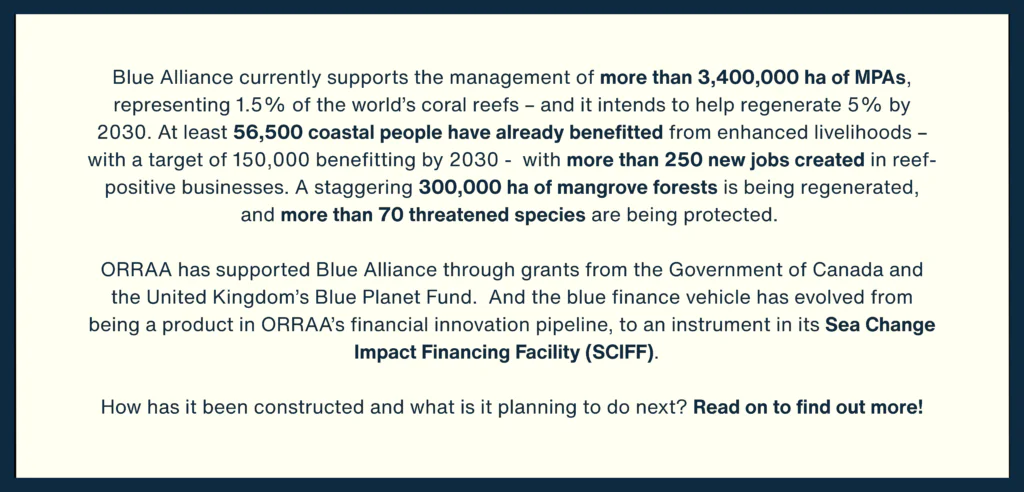
Blue Alliance now supports the management of more than 3,400,000 ha of MPAs, representing 1.5% of the world’s coral reefs. At least 56,500 coastal people have benefitted from enhanced livelihoods, with more than 250 new jobs created in reef-positive businesses. A staggering 300,000 ha of mangrove forests is being regenerated, and more than 70 threatened species are being protected.
Beyond its initial funding from the Government of Canada, the vehicle continues to bring in a steady stream of grants, refundable grants, climate insurance and impact loans, demonstrating a rise in investors’ confidence in the model. To date, supporters include UBS Optimus, the Global Fund for Coral Reefs, Bloomberg Foundation, Trafigura Foundation, AXA Climate and the UN Capital Development Fund.

What’s more, the Blended Finance Vehicle has now been formally adopted by ORRAA’s Sea Change Impact Financing Vehicle (SCIFF), a suite of financial instruments that mutually reinforce each other to establish a capital market for the Ocean, building investors’ confidence and creating the market infrastructure for capital to flow at scale.

Indonesia: Testing the model in Banggai
As the vehicle finds its feet, taking different shapes in different countries and contexts, the clearest example of its approach has come to fruition in Indonesia.
ORRAA’s support and funding through ORRAA from the UK Government’s Blue Planet Fund is enabling the deployment of a scalable financial model covering 800,000 ha of MPAs in Banggai, Central Sulawesi, where coral reefs provide essential coastal protection to climate-vulnerable communities in the region.
Blue Alliance is officially responsible for managing the MPA network, while catalysing four reef-positive businesses ranging from community-based aquaculture and sustainable fisheries to ecotourism and blue carbon credits. The blended finance vehicle mitigates the risk of investing in these businesses, enabling them to attract private debt capital and other forms of investment. By working specifically with reef-positive ventures, Blue Alliance ensures that the supported enterprises benefit from reef protection, rather than destruction. This creates a mutually beneficial cycle, with healthy reefs generating profits, a portion of which are then reinvested in MPA management.
In addition to improving the management and protection of 800,000 ha of coastal ecosystems, the Banggai project is expected to support around 11,000 individuals and create at least 120 full-time jobs.
Scaling the vision
This progress is just a fraction of what Blue Alliance’s blended finance vehicle will achieve when fully scaled. By 2030, the organisation intends to regenerate 5% of the world’s coral reefs (9 million ha in total), benefiting more than 150,000 people.
Ultimately, Blue Alliance is proving that MPAs can be the solution they always promised to be. All it takes is an understanding of local needs, and the vision to integrate those needs with effective MPA management. With these pieces in place, finance begins to flow in a way that benefits people and planet.
Sign up for the ORRAA News
A quarterly round-up of news, highlights and opportunities from the Ocean Risk and Resilience Action Alliance